
Why Your Kitchen Tools Might Be Secretly Plotting Against You
You don't need new gadgets, just smarter ways to use what you already own.
Ever get that sneaking suspicion your kitchen is subtly working against you? The garlic press that mashes more knuckle than clove, the supposedly non-stick pan that holds onto that omelette for dear life, the drawer that devours the one tool you desperately need? It feels personal, doesn't it? Like your own pots, pans, and peelers have formed a tiny, malevolent union dedicated to making dinner prep a comedy of errors. But before you rage-quit and order that shiny new gadget promising culinary salvation, hold on. The problem might not be your tools. It might be how you're using them.
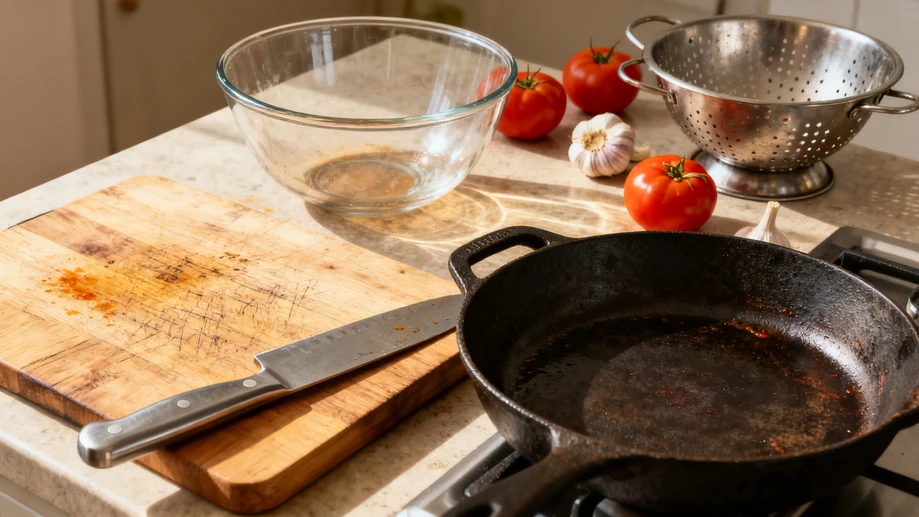
We live in an age of incredible kitchen innovation. It's tempting to believe the solution to every cooking woe is the next whiz-bang appliance. However, constantly chasing new gear often overlooks the true potential sitting right in our drawers. Think about that bread knife you only use for, well, bread. Ever tried it on a perfectly ripe summer tomato? A serrated bread knife, used with a gentle sawing motion, glides through tomato skin without crushing the delicate flesh underneath, leaving you with pristine slices – no fancy tomato knife required. Or consider the humble colander. Sure, it drains pasta, but flip it upside down over a bowl, and suddenly it becomes a fantastic steamer basket for vegetables or dumplings. The tools are versatile; we just forget to explore their full range.
Many common kitchen frustrations stem not from tool inadequacy, but from simple misuse or misunderstanding. Take the notorious sticking pan. Often, the culprit isn't the pan itself, but heat control. Plopping food into a cold pan or cranking the heat too high guarantees adhesion. Preheating your pan gently over medium heat and ensuring your food is dry (pat that protein dry!) before adding oil can work wonders, transforming even a basic pan into a reasonably non-stick surface. Similarly, that garlic press that causes so much grief? It's usually designed for peeled cloves. Trying to force an unpeeled clove in is a recipe for frustration and potential injury. A quick smash with the flat side of your chef's knife makes peeling effortless *before* pressing.
Mastering a few fundamental techniques is infinitely more liberating than amassing gadgets. A sharp chef's knife is arguably the most powerful tool in your kitchen, far exceeding the utility of unitaskers like avocado slicers or strawberry hullers. Learning proper knife skills – how to hold it, how to chop, slice, and dice efficiently and safely – speeds up prep dramatically and opens up a world of cooking possibilities. Understanding heat – the difference between a simmer, a boil, and a sear, and how different pans conduct heat – is another game-changer. This knowledge lets you adapt your existing tools to countless tasks, making you feel far more in control than any single-use appliance ever could.
Instead of feeling sabotaged by your current kit, see it as an opportunity for rediscovery. Open that chaotic utensil drawer not with dread, but with curiosity. Pull out that whisk gathering dust – could it whip aquafaba for a vegan mousse? Could that sturdy mixing bowl double as a container for proofing dough? Could the peeler you only use on potatoes effortlessly create delicate ribbons of zucchini for a salad? Experiment! Look at your familiar tools with fresh eyes. You might be surprised by the hidden talents lurking in your cabinets. Reconnecting with and reimagining the use of your basic tools fosters creativity and builds genuine kitchen confidence. You stop being a slave to instructions designed for specific gadgets and start becoming the confident commander of your culinary domain.
So, the next time your kitchen feels like it's conspiring against you, resist the urge to immediately blame the tools (or buy a new one). Pause. Reassess. Is it really the garlic press, or is it the unpeeled clove? Is it the pan, or the heat? Often, the answer lies in a slight adjustment in technique, temperature, or simply remembering the other jobs a tool can do. By focusing on understanding and maximizing what you already have, you'll not only save money and counter space, but you'll also unlock a far more satisfying and capable cooking experience. Your tools aren't plotting against you; you just needed to learn their secret language. Now, go outsmart them.