
Unnoticed Tiny Daily Habits That Extend Over-Ear Headphones’ Service Life By Years
Most headphone damage that users assume is factory defect is actually caused by trivial daily misoperations that can be easily avoided with simple adjustments.
A large number of over-ear headphone owners report that their devices start to show obvious wear and tear after only six months to one year of use. Common issues include peeling headband cushion leather, loose audio cables, unbalanced left and right channel output, and poor passive noise reduction effect. Most users immediately attribute these problems to poor product quality, and even go through complicated after-sales application processes to ask for replacements, only to find that the new device they get will run into exactly the same set of problems after a few months of use. Very few people realize that these annoying problems are almost never caused by original manufacturing flaws, but are the cumulative results of small, unnoticeable misoperations during daily use.
The most common bad habit that most people develop unconsciously is storing the headset in a stretched state for a long time. Many office workers hang their over-ear headphones on the edge of the monitor frame as soon as they take them off after finishing video calls, and keep the headband in a maximum stretched state for several hours. Others throw the headset directly on the desk with heavy items pressed on the top of the headband for the whole night. The elastic structural parts inside the headband are designed to maintain a certain stretching range for dozens of hours of accumulated use, and long-term forced stretching will make the internal metal fatigue quickly and lose its original elasticity. After that, the headset will easily slip down when users wear it, and can not fit the head shape tightly to achieve the ideal noise isolation effect. Another extremely common misoperation is pulling the audio cable directly to take off the headset, instead of holding the main body of the headset to lift it. Repeated force on the welding position of the cable and the internal control board will make the solder joint loose or even break completely in just a few months.
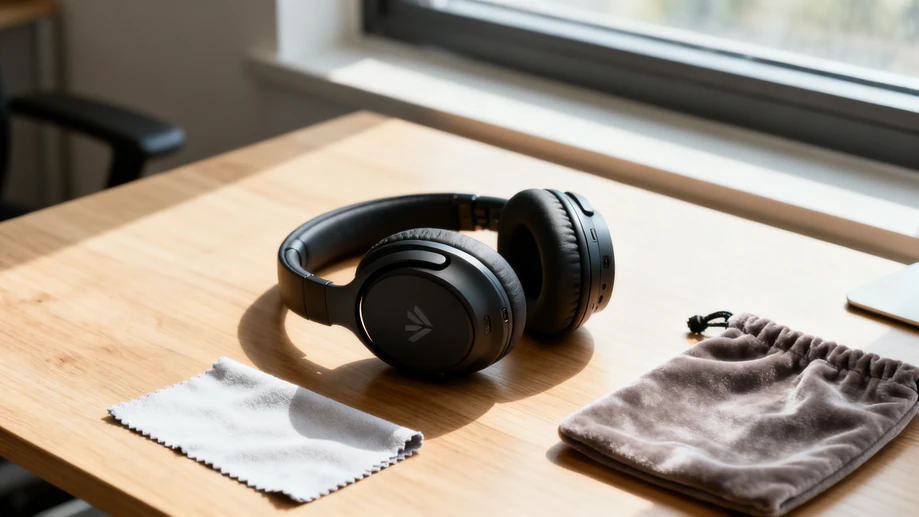
Another key point that most users ignore is regular cleaning for the earmuff surface. The average person wears over-ear headphones for at least 3 hours every day, whether commuting on public transport, working in the office or playing games at home. The protein leather or fabric earmuffs will gradually accumulate sebum secreted by facial skin, sweat residue, and particles of hair styling products over weeks of contact. If these stains are not cleaned for months, they will not only breed bacteria and produce unpleasant sour smell, but also block the tiny sound-permeable holes on the surface of the earmuff. Many users find that the sound quality of the headset becomes much duller than when they first unboxed it, and mistakenly think that the internal speaker unit has been damaged, but the real cause is just the blocked air holes on the earmuff. It only takes 30 seconds every week to wipe the earmuff surface gently with a soft lint-free cloth slightly dampened with clean water, to keep the earmuff as clean as new. It is worth noting that alcohol-based disinfectants or oily cleaning products can never be used on the earmuff leather, as they will dissolve the surface coating of the leather and cause cracking in a very short time.
When users need to carry the headset out for travel or commuting, proper storage also plays a huge role in extending the service life. It is not recommended to stuff the headset directly into a fully packed side pocket of the backpack along with metal keys, hard data cables and other sharp small objects. Hard squeezing will easily make the internal sound unit shift out of its fixed position, leading to unbalanced volume of left and right channels. A soft shockproof storage bag of proper size can keep the headset fixed in its natural folded state, without being squeezed by external hard objects. Even if the backpack is accidentally dropped from a height of one meter, the internal structure of the headset will not be affected at all.
All these maintenance methods do not require any additional investment of money or a lot of extra time, and they can be integrated into people’s daily routine very easily. Many long-time headphone users who have developed these good habits say that their over-ear headphones can keep the original excellent wearing comfort and top sound quality even after five or six years of continuous use. For anyone who has spent a considerable sum of money to buy a pair of over-ear headphones, these tiny habits are the most cost-effective way to maximize the value of their purchase, far more practical than buying expensive extended warranty services or extra replacement accessories.