
The Toy That's Secretly Teaching Kids Quantum Physics
How simple playthings are unlocking complex scientific concepts for the youngest minds.
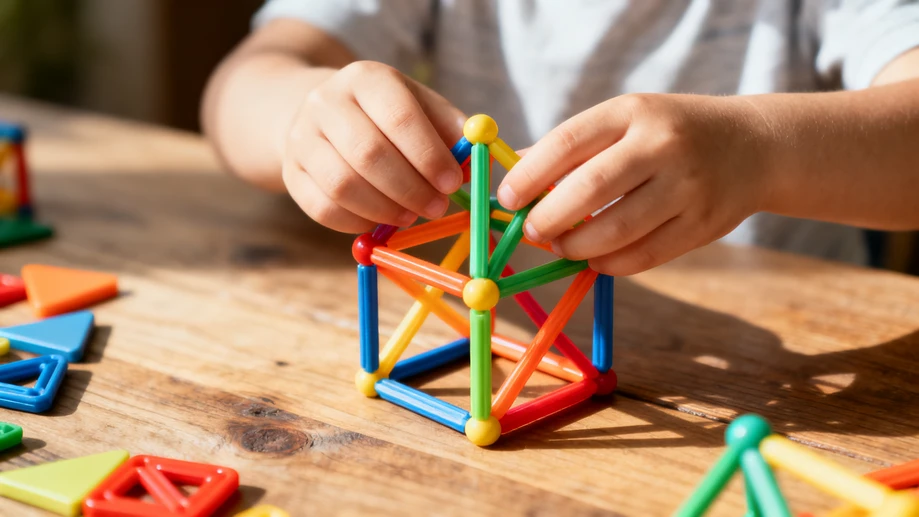
Picture this: a five-year-old intently stacking colorful, interlocking blocks. To the untrained eye, it’s just another play session. But look closer. Those blocks aren’t just forming a wobbly tower; they’re demonstrating the fundamental principles of atomic bonding. Welcome to the quiet revolution happening on playroom floors everywhere, where ordinary toys are becoming extraordinary tools for introducing mind-bending scientific ideas.
Forget flashcards and rote memorization. The magic lies in tactile exploration. Tiny hands manipulating magnetic tiles that snap together with satisfying clicks aren't just building castles; they're experiencing attraction and repulsion firsthand, mimicking the forces holding molecules together. The seemingly random jiggle of beads suspended in clear liquid inside a sealed tube? That’s a mesmerizing, child-safe introduction to Brownian motion and the constant dance of particles. These toys don’t lecture; they invite curiosity through pure, unadulterated fun.
What's truly fascinating is how these concepts land. Children don't approach them with the baggage of "this is hard science." They simply engage with the cause and effect. "Why does this magnet stick *here* but push *away* over there?" becomes a genuine puzzle to solve through experimentation, not a chapter in a daunting textbook. This organic discovery process builds intuitive understanding long before complex terminology enters the picture. It’s science literacy built on a foundation of wonder.
Parents and educators are noticing the shift. Conversations sparked by these toys are surprisingly profound. A simple marble run becomes a discussion about gravity, momentum, and energy transfer. A set featuring gears and levers effortlessly leads to talks about mechanics and simple machines. The toys act as physical metaphors, making abstract theories tangible. The feedback is consistent: kids exposed to these playful introductions show greater confidence and interest when encountering similar concepts later in formal education. They’ve already 'felt' the science.
Naturally, this playful pedagogy has its skeptics. Can a preschooler truly grasp quantum concepts? Experts clarify that the goal isn't mastery, but familiarity and comfort. Neuroscientists point out that early exposure to complex patterns and systems, even without deep understanding, builds robust neural pathways. It’s about planting seeds. When children later encounter Schrödinger's cat or electron clouds in high school, there’s a flicker of recognition – a hazy memory of patterns explored years before with their favorite toys. This foundational comfort reduces the intimidation factor significantly.
The implications extend beyond future physicists. This approach demystifies science, presenting it not as an exclusive club for geniuses, but as an exciting exploration accessible through play. It cultivates critical thinking, problem-solving, and a resilient "let's figure this out" attitude. Watching a child persistently redesign a structure after it collapses isn't just play; it's the scientific method in action – hypothesis, test, observe, refine.
So, the next time you see a child engrossed in what looks like simple block play, take a second look. That intricate structure might just be their first model of a carbon atom, and those focused eyes are witnessing the invisible forces of physics in action. It's proof that sometimes, the most profound lessons come wrapped in the simplest packages, proving that play really is the highest form of research – even when it involves toy quarks.