
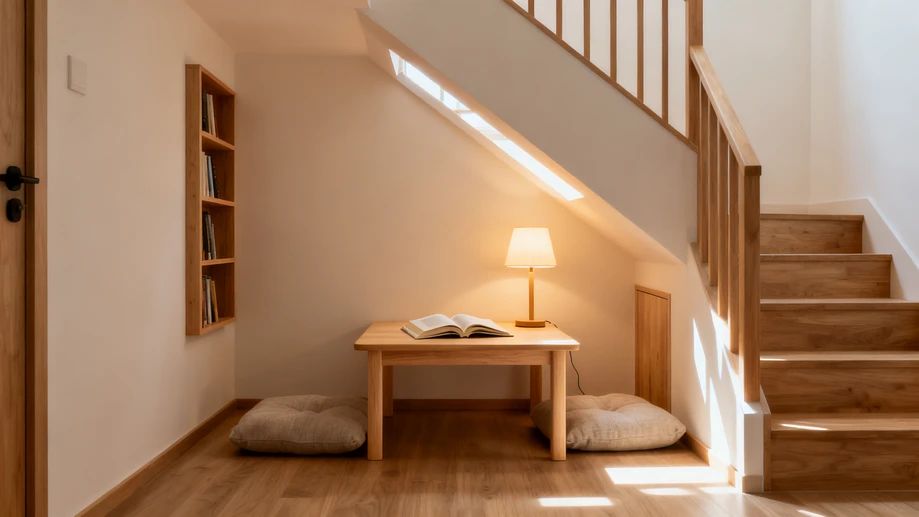
The Quiet Magic of Tucking a Work Nook in the Unused Space Under Stairs
Many households overlook under-stair space as a valid work spot, and it comes with far more perks than most people assume.
Recent home renovation surveys show over 68% of people planning a dedicated work space prioritize unobstructed wide views and at least 1.8 meters of desk surface, under the assumption that extra space and large doses of natural light equal higher productivity. The reality for most of these setups is constant low-grade distraction: stray passersby through adjacent rooms, bright midday sun that glares off laptop screens, and random small household tasks that keep drifting into the line of sight to pull focus away from ongoing work. A large number of these fancy, full-size home offices end up as storage zones for unopened delivery parcels, out-of-season bedding and unused sports equipment, while people end up doing most of their actual focused work on the narrow kitchen counter or the edge of the dining table.
For decades, the space under residential stairs has been written off as a useless dead zone, reserved for stacking old suitcases, expired grocery items, and broken children’s toys no one can bear to throw away. This oddly shaped, partially enclosed spot actually comes with a natural three-sided enclosure from stair risers and side panels, no extra screens or dividers required. The moment a person steps into this small pocket, the line of sight automatically narrows to the small flat surface directly in front of them, no wide open field of vision scattered with random household items to pull attention away. It fits a small 80-centimeter desk, a padded work seat and a narrow wall-mounted bookshelf perfectly, without taking up any valuable public activity space in the rest of the home.
A common concern for people looking to convert this spot is lack of natural light, but most studies on long-term screen use prove that harsh direct sunlight causes far more eye strain than soft artificial lighting. A warm-toned desktop lamp paired with a slim wall-mounted reading strip delivers even, glare-free light that falls exactly on open books and keyboard surfaces, making long hours of reading or writing far more comfortable than a sun-drenched large desk near the window. The semi-enclosed structure also has surprisingly good natural sound absorption: wood stair panels absorb most faint background noise from running washing machines, distant doorbells and neighborhood construction work, softening all distant sounds to a quiet, unobtrusive murmur that will never snap a person out of deep focus unprompted. Many full-time writers and independent creators report that they enter deep work state three times faster in this small nook than they do in a sprawling open home office.
Another underrated perk of this tucked-away work spot is its extremely strong sense of exclusive belonging. Unlike a large open home office that can easily get taken over by a visiting guest, a family member who needs to print documents quickly, or a pile of random craft supplies, the small under-stair nook is just big enough for one person, so no one else will casually move in their items or claim the space for temporary use. Over time, a subtle unspoken social rule forms among all household members: when someone is sitting inside that small nook, they are in the middle of focused work, and no casual small talk or trivial questions are allowed to interrupt. Many regular users build tiny consistent little habits for the spot, like placing a specific tin of mints at the top right corner of the desk, or using the same chipped ceramic mug for every cup of tea during work hours. These tiny fixed details turn into a built-in focus trigger for the brain, signaling immediately that it is time to leave casual home mode and dive straight into deep work or immersive reading.
Most people’s idealized vision of a perfect home studio is loaded with unnecessary high-end upgrades, from height-adjustable desks to full walls of curated decor pieces, but very few of these fancy installations address the core psychological need for deep focus: a gentle sense of enclosed safety. An under-stair nook costs less than one tenth of the budget of a full-scale large home office, but it delivers that quiet, unshakable feeling of being fully protected from all outside distractions, which is impossible to replicate in a wide open, over-exposed setup. Many people who have renovated this tiny space report that they finished a 300-page nonfiction book they had been putting off for months in less than a week, and wrapped up a long-delayed work project three days ahead of schedule. It does not need to be a photo-ready display space for social media, it only needs to hold all of one person’s full concentration, and that makes it the most functional study space a regular home can offer.