
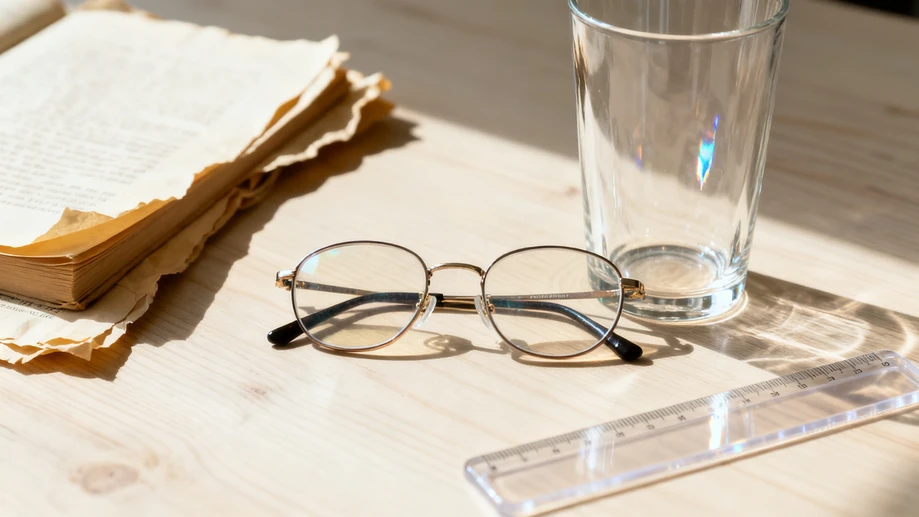
Have you ever wondered why your daily wear eyeglasses never slip off your nose when you lean fully forward?
This little-known physical design rule built into almost every regular eyeglass frame shapes dozens of tiny unnoticeable moments in your daily routine.
Most people who wear glasses for years have the weirdly familiar experience, no matter they are nearsighted or farsighted, that they can bend all the way down to pick up a pen dropped under the desk, stretch their upper body forward to check the food being baked in the lower layer of the oven, or even crawl slowly on the floor to look for a lost contact lens case, and their glasses stay perfectly rooted on the bridge of their nose without them needing to reach up and adjust once. There is no sweat to add extra friction, no rubber pads stuck on the nose pads to increase grip, the frames just sit there steady as if glued in place, even when your face is pointed directly at the ground with the top of your head facing the ceiling.
But the second you tilt your head all the way back to check the tiny crack on the ceiling, or look up at the top shelf of the bookcase that holds your long-unread collection, the same pair of glasses will start to slide down your nose immediately, and you have to lift one finger to push it back up to the correct position before it falls right off and clatters to the floor. This small inconsistent performance never gets much attention, and most people just assume the frames are getting loose after months of wearing, or the natural skin oil on their nose reduces the friction that day, but the actual reason is far more intentional than random wear and tear.
Every standard non-sport eyeglass frame is designed with a pre-set forward tilt of 6 to 8 degrees, which means the bottom edge of the lens always sits slightly closer to your face than the top edge does when you hold your head level. This angle is not made for aesthetic needs, but calculated completely according to basic force decomposition in physics. When you lean your body and head forward, the direction of gravity on the whole frame shifts, the total downward force no longer pulls the nose pads away from your skin, but presses them tighter against the two soft spots on the sides of your nasal bridge, while the two arms of the frame that hook behind your ears generate a tiny backward pulling force that cancels out any possible horizontal sliding movement. You do not even feel the extra pressure, but the whole structure forms a self-locking system completely automatically.
This design feature is so well integrated into the product that most people who work at optical shops rarely explain it to new customers, even when they spend 10 minutes adjusting the angle of the nose pads after you pick out a new frame. Many customers mistakenly think the optician is making the frames tighter to squeeze their face to stay in place, but they are actually fine-tuning this 6 to 8 degree tilt to make sure the self-locking mechanism works properly no matter what gentle movements you make in daily life. A well-adjusted pair of frames will never leave deep indent marks on your sides of the nose after 12 hours of wearing, even if you work long hours leaning over your desk to type, because the force is distributed evenly rather than being applied as tight clamping pressure.
You can test this tiny function at home right now if you have a pair of regular glasses at hand, just hold the frames by the two arms, tilt the whole frame forward at that 7 degree average angle, and place the nose pads on the smooth surface of a glass cup that is placed upside down, the whole frame will not slide off at all even if you tap the side of the cup gently. All those little unconscious habits you have developed over the years, like tilting your head slightly down to read a text message on your phone, or tilting your head up for a second to adjust your glasses before you look at the starry sky at night, are all influenced by this tiny hidden design that no one ever tells you about. It is these small, unspoken physical design details that make the most common daily objects feel almost perfectly adapted to the way we live our lives.